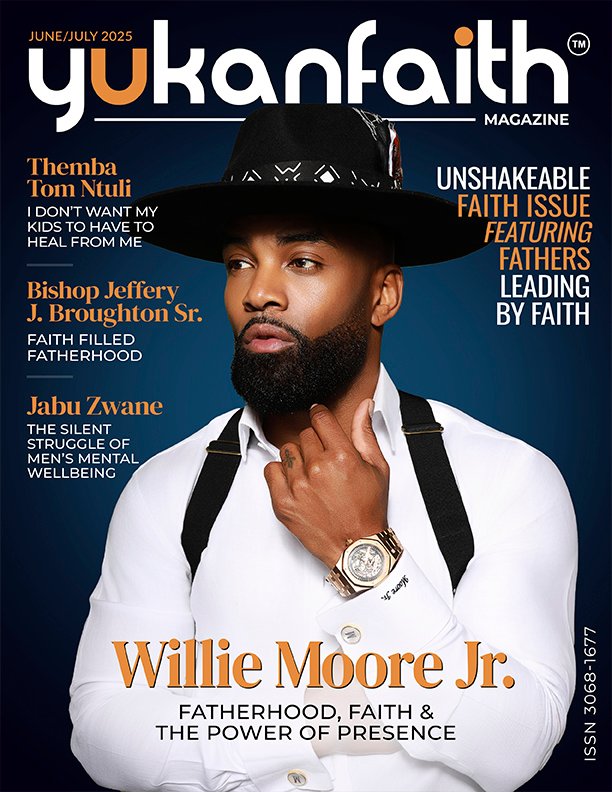
Faith, Fatherhood and the Fragile Power of Presence
The Humanity of my Christianity
Willie Moore Jr.
Willie Moore Jr. does not hide his tears. In fact, he counts them—four times a week, to be exact—and he makes sure his children see every single one. In a world that still too often equates fatherhood with stoic silence and emotional reserve, Moore is a living contradiction: a national radio host, author, and speaker who leads with vulnerability, grounded in a deeply personal walk of faith.
But beyond the titles and public persona, Moore’s most sacred identity is found in the home. There, he is a father first—and not just a provider or disciplinarian, but a living, evolving testament to grace, change, and emotional presence. “I let them know Daddy cries four times a week… and I let them see it,” he shares, his voice steady, his conviction unwavering. In Moore’s house, transparency is not optional. It is a spiritual discipline.
Redemption at the University of Mississippi
One of his most profound experiences of redemption unfolded recently, not at a pulpit or conference stage, but in a cap-and-gown moment that took him full circle. “Three weeks ago, my 22-year-old son graduated from the University of Mississippi,” Moore recounts. It was a milestone laced with meaning. At the same age, Moore had received a full scholarship to that very university but never completed his degree. “So here I am, traveling throughout that city on the same streets that I goofed off on… with my son.”
That moment was not just closure—it was spiritual inheritance. “I did not get the opportunity to complete my degree, but because I passed the time… my son was able to do it.” It was not about achievement; it was about redemption. “That was something that impacted my relationship and faith in God like never before.”
Learning God’s Love Through His Imperfections
Moore’s evolving theology has been shaped less by doctrine and more by diapers, teenage angst, and the high stakes of fatherhood. Loving his children unconditionally has helped him understand God’s love in a radically new way. “There is nothing I can do to outrun, to out-sin, to outdo the love of God,” he says. “He can never love me any more than He loves me right now.”
That realization did not come from study; it came from presence—from choosing to stay, to listen, to be transformed in full view of his kids. “There’s no grade, no mistake, no amount of failure… not even an amount of disrespect that changes my love for [my children],” he says. “Once I was able to see that those attributes can be in me—and I’m nothing more than a mortal—it challenged me. How much does God love me… and how much am I putting a burden on myself to be perfect when God loves me through my imperfections?”
In the last five years, Moore’s home has become a sanctuary in more ways than one. Following what he calls “a very unique blow,” he chose not to shield his children from the struggle but to invite them into the transformation. “They saw Dad one way… and saw Dad become another way,” he says. The transformation was not just emotional—it was physical and spiritual. He cleaned out a closet and turned it into a sanctuary. He quit drinking. He reshaped his body. He recommitted to church, to mentorship, and to God. “This is what it looks like,” he says. “This is what it looks like to change.”
Faith, for Moore, is not a theory—it is a lifestyle. “I’m just thankful that they’re with me full-time,” he says of his children. “So I can show them the ins and outs, the ups and downs to faith… because it’s not a cakewalk.”
The Discipline of Gentleness
He carries a quiet principle in his parenting, one rooted in scripture: Proverbs 15:1—“A gentle answer turns away wrath.” For Moore, gentleness is not weakness; it is wisdom. “When children are going through emotional moments, parents have a tendency to shrink down to being a child too,” he observes. “But the more gentle I am, the more understanding I get. The more curious they can be.”
And curiosity, he believes, is the gateway to growth.
That philosophy extends to the controversial notion of being friends with one’s children. Moore does not shy away from it. “I just believe that a healthy friend does three things: they support you, they challenge you, and they direct you when you don’t know what you’re doing,” he says. “I’m friends with my children—and they can tell me anything.”
Letting Them See It All
Asked what single piece of advice he would offer other fathers, Moore does not offer a platitude. He reaches for scripture. “I’d say follow the Bible—not just for the words, but for the principles,” he says. “Nothing is omitted about the ups, the downs, and the failures.” Like Abraham, who moved forward without a map. Like Jesus, who walked from celebration to crucifixion. That, he says, is the journey of fatherhood—sacred and sometimes sorrowful, but never solitary.
And that is why he shows them everything. The victories. The mistakes. The weeping. “Whether it’s tears of joy… or unique times. Daddy cries. Because Jesus also wept.”
In a culture of curated perfection, Moore’s message is clear: do not hide your humanity. Embrace it. Share it. Let your children see it all. “I leave all those cards on the table,” he says. “And I make sure they understand what those cards are.”
Ultimately, Willie Moore Jr. is not trying to raise perfect children. He is modeling what it looks like to be a present, honest, and faithful man in progress. And in doing so, he offers his children—and the world—a rare, deeply human glimpse into the heart of Christian fatherhood.
A Father Unfolding
In every story Moore shares, one theme pulses: humanity is not a flaw—it’s a gift.
His children don’t love him because he’s flawless. They love him because he’s real. And in letting them see his process, in tears and triumph, Willie Moore Jr. gives them—and us—a deeply human picture of what faithful fatherhood can look like.
No edits. No masks. Just truth!
June/July 2025: Willie Moore Jr.