The Structure Beneath the Calling
In a season defined by resurrection, things declared finished that refuse to stay buried, I want to make the case that what most ministry leaders need is not more faith. It is a better architecture.
By Bishop Dr. Loretta Sanders
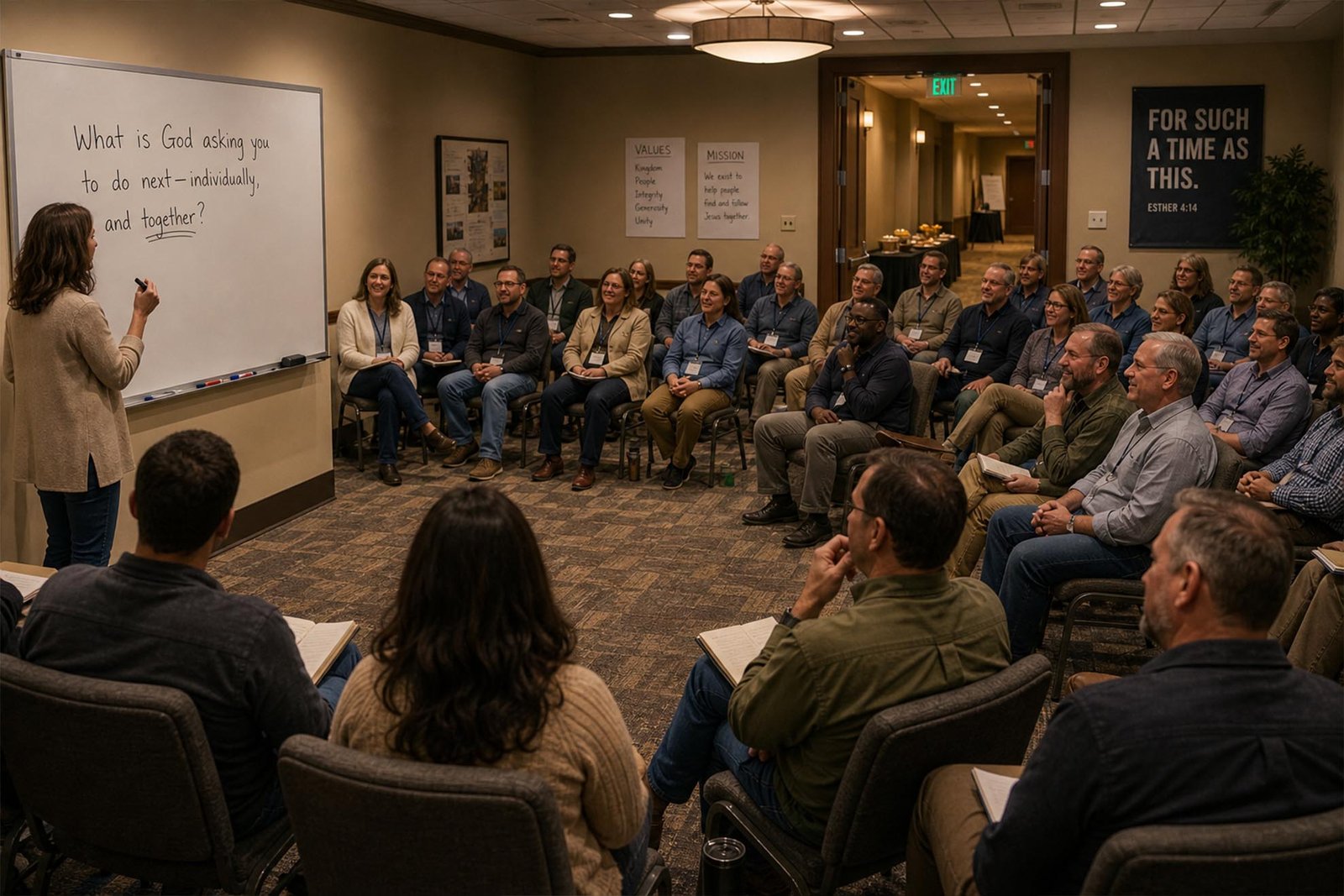
Picture a room at the end of a leadership conference. It is just after five o’clock, dinner is waiting somewhere down the hall, and not one of the forty ministry leaders seated in a loose semicircle has moved toward the door. Someone is at the whiteboard, marker uncapped, and she has just asked a question I have asked in rooms like this one, across boardrooms and church offices and volunteer training sessions, more times than I can count. The question is always the same. So is the silence that follows it.
“When was the last time someone on your team disagreed with you, and meant it?”
I have learned, over more than twenty-five years in organizational leadership and ten years as Senior Pastor, to read that silence. Its length tells me almost everything I need to know about the culture of the organization sitting in front of me. A quick answer means the leader has not yet understood the question. A long silence means they have understood it perfectly and cannot think of an example.
In rooms like the one I am describing, the silence often lasts a very long time. I do not fill it. I let it do its work. Because the silence itself is the beginning of the diagnosis.
★ ★ ★
After more than twenty-five years of doing this work, across boardrooms and break rooms, in church offices and volunteer huddles, in conversations with Senior Pastors and volunteer coordinators on four continents, I can tell you with certainty what the diagnosis almost never is. It is almost never the people. And it is almost never the calling.
The problem is the structure, and we have been calling it something else for too long.
This is a season that carries particular weight for those of us who lead from faith. March and April hold both Women’s History Month and Easter together, the commemoration of women who led before permission was granted, folding into the story of resurrection, of things declared finished that refused to stay finished. The leaders I am most concerned about are not the ones who lack courage or conviction. They are the ones who have both and who operate within structures that were never designed to bear the weight of what they were called to carry.
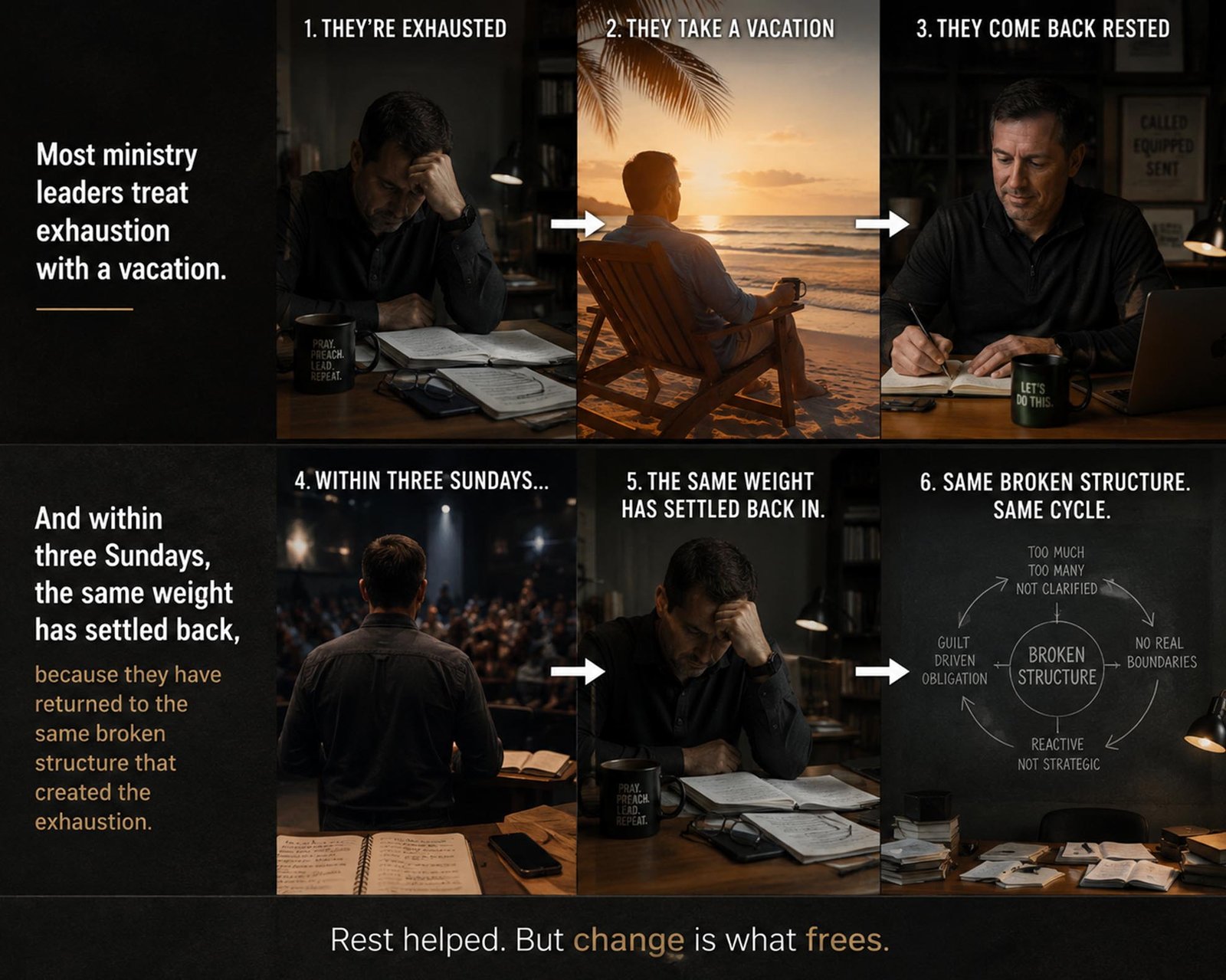
Most ministry leaders treat exhaustion with a vacation. They come back rested, and within three Sundays, the same weight has settled back, because they have returned to the same broken structure that created the exhaustion. A headache pill does not fix a brain tumor. No amount of sabbatical fixes a bad organizational chart.
★ ★ ★
Over the past decade, I have been developing what I call the Three Dimensions of Sustainable Leadership, built on organizational management and scripture. Structural excellence, psychological safety, and spiritual vitality. When all three are operating, a ministry team does not just survive, it scales. When all three are broken, the leader becomes the single point of failure for everything beneath them.
I trace this pattern to Elijah, who collapsed under a juniper tree in the wilderness and asked God to let him die. The standard reading is that Elijah was spiritually depleted. After twenty-five years of sitting across from leaders in that same condition, I read it differently.
Elijah was not spiritually empty. He was structurally alone. He had been operating as the only prophet standing, with no team beneath him, no distributed leadership, no infrastructure. The moment external pressure arrived, the entire system collapsed. Because the entire system was one man. I have watched that collapse happen across four continents. It looks the same every time. It is not a crisis of faith. It is a crisis of architecture.
God’s solution to structural collapse was never more solitude. It was always community, covenant, and distributed strength.
What God’s response to Elijah reveals is not simply pastoral care; it is architectural correction. Before offering a new vision, God offered rest and a partner. When Elijah’s ministry was relaunched, Elisha was beside him. The resurrection required reconstruction. The leaders who built something that lasted built the team first. And then the team built the mission.
★ ★ ★
There is a particular kind of organizational failure I call “artificial harmony” that is among the most costly problems a ministry can carry without knowing it. Artificial harmony is not peace. It is the performance of peace. It develops when a team has learned that certain truths are not welcome, that disagreement has a cost, and that honesty is risky. So they stop offering it, not because they stopped caring about the mission, but because silence feels safer than speaking.
The early church was not immune. In the weeks following Pentecost, a culture of radical generosity had taken hold. A leader named Barnabas had sold a plot of land and laid the full proceeds at the apostles’ feet, an act celebrated as the standard of total commitment. It was into that charged atmosphere that Ananias and Sapphira arrived, having kept back part of the proceeds from their own sale and presented the remainder as the whole.
Most people read that story as individual dishonesty. I read it as a failure of leadership culture. They lied not because they were uniquely corrupt, but because the room had made honesty feel more dangerous than deception. The culture rewarded total sacrifice so thoroughly that partial sacrifice felt like failure. That is a structural problem. And it is one I have walked into more times than I can count.
Once performance is permitted in a culture, you no longer have a community. You have an audience. And audiences do not build ministries. Communities do.
★ ★ ★
I speak with particular directness to the women reading this. You have led for years in rooms not designed to include you. You have done the invisible work of keeping organizations moving without the recognition it deserved. Women’s History Month is not simply a commemoration. It is a diagnostic of the present. The women who changed history did not wait for the structure to invite them. They built the structure their calling required.
Leadership begins the moment you stop waiting and start responding. Not with everything figured out. With the conviction that you were called to build something that outlasts you, and the willingness to do the invisible, foundational work that makes it possible.
The resurrection was not a return to what was. It was the construction of something the world had not yet seen.
That is the call I am extending to every leader reading this. Not to a platform or a title. To the quarry, the quiet, structural, preparatory work that happens before anyone sees the temple. The stones for Solomon’s temple were cut miles from Jerusalem, so that when they arrived at the building site, they fit perfectly. No rework. No noise. The most consequential work he did was invisible to the people he led. And the glory did not show up during construction. It showed up after.
The sessions are over. Dinner is getting cold. But no one has moved. That, in my experience, is what it looks like when a question lands where it was supposed to. Some of the leaders in that room will be answering it for years. That is exactly what it is supposed to do.
If you are ready to build listen to Dr. Loretta’s Podcast at www.youtube.com/@YukanfaithTV. Subscribe so you don’t miss an episode
Bishop Dr. Loretta Sanders explores these themes in her weekly podcast Serve. Lead. Scale. | From Spiritual Fumes to Strategic Expansion, available on Spotify and YouTube. A free Ministry Capacity Micro-Audit for leadership teams is available at yukanfaith.com/leadership.
Bishop Dr. Loretta Sanders is a leadership architect, Master Trainer, and international speaker with over twenty-five years of ministry leadership experience and ten years as Senior Pastor. She is the founder of YuKanFaith and Bold and Brave Events & Publishing, and has served as a pioneer leader in ministry and education globally.
March/April 2026: Bishop Dr. Loretta Sanders