Why the wisest investor in the room is the one who knows what he does not know
Long before Wall Street had a name, before a single share certificate changed hands, before any economist had drawn the first efficient frontier on a chalkboard, an old king set down a sentence that would outlive every market he could imagine.
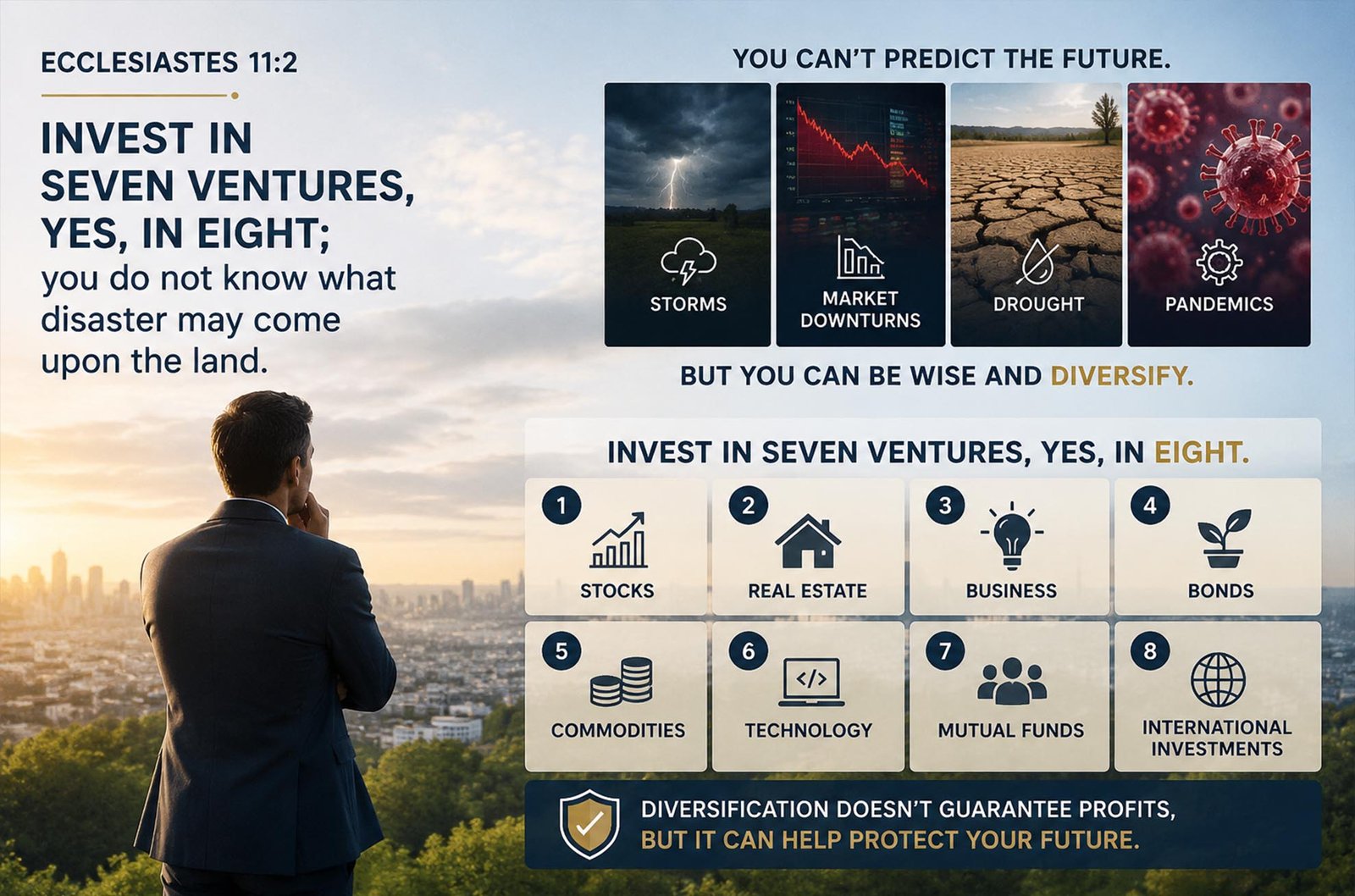
“Divide your portion to seven, or even to eight, for you do not know what disaster may befall the land.” — Ecclesiastes 11:2
Three thousand years later, men in glass towers in Manhattan, London, and Dubai run sophisticated models built on the same instinct. They call it diversification. The Preacher of Ecclesiastes called it wisdom.
The difference between those two words is the subject of this column.
A Theory Older Than the Theory
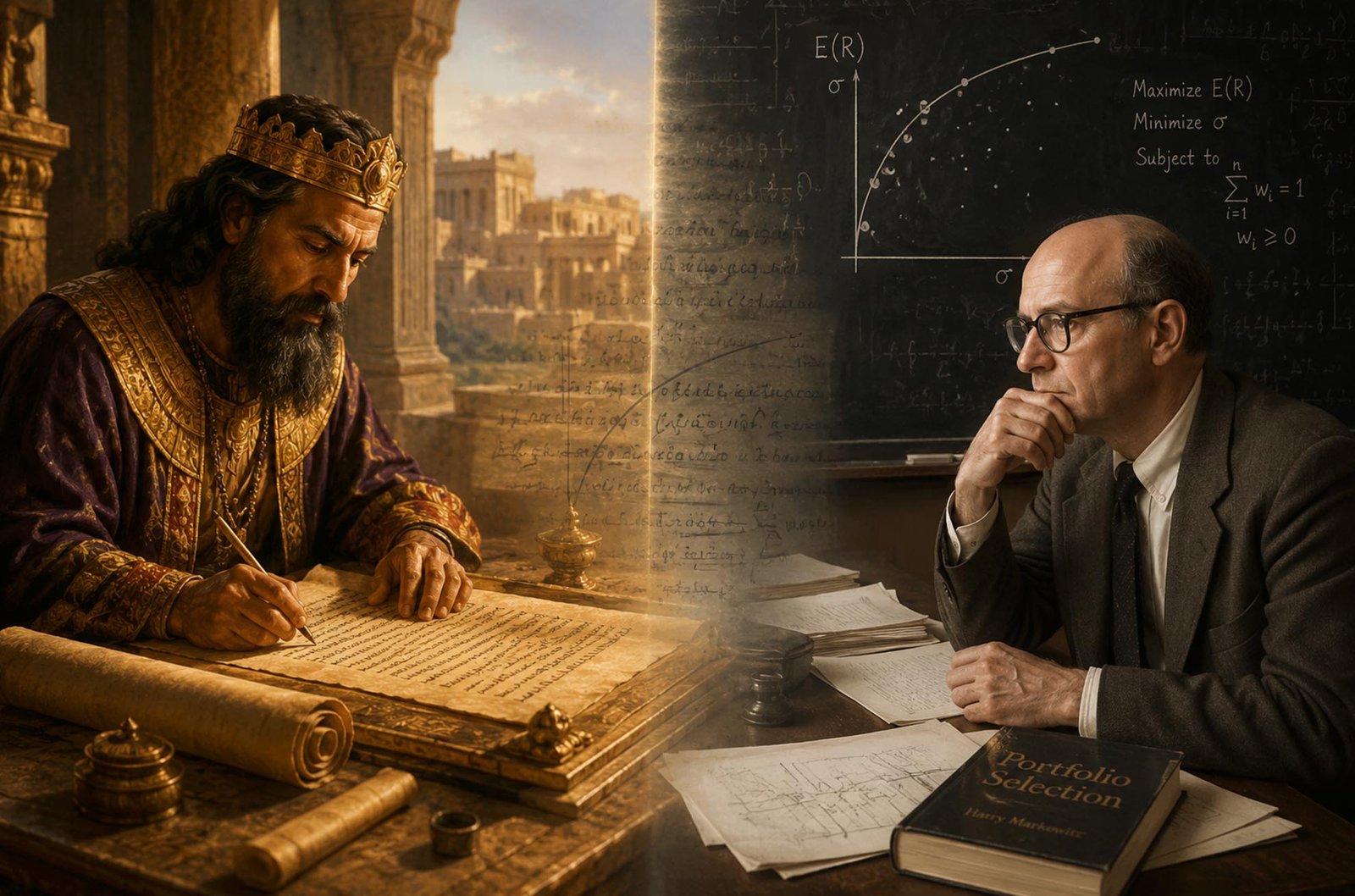
In March 1952, a 24-year-old graduate student named Harry Markowitz published a fifteen-page paper in The Journal of Finance titled simply, “Portfolio Selection.” That paper became the foundation of what is now called Modern Portfolio Theory, and it eventually earned its author a share of the 1990 Nobel Prize in Economics. Markowitz’s contribution, in essence, was to give mathematical form to a very old idea: that an investor reduces risk not by predicting the future, but by spreading exposure across many futures at once.
Markowitz did not invent diversification. He measured it. He proved it. He gave it a graph.
But the principle he formalized had already been operating in the marketplaces of Tyre and Sidon, in the grain ships sailing from Egypt, in the merchant caravans that crossed the desert from the Arabian peninsula to the Levant. It was the principle that kept ancient households alive across droughts and wars and the slow grind of bad seasons. And it was the principle the writer of Ecclesiastes pressed into a single, memorable line: seven, or even eight.
What is striking is not that Solomon anticipated Markowitz. It is that Markowitz, three millennia later, could not improve on Solomon’s reasoning.
The Sentence Behind the Sentence
To read Ecclesiastes 11:2 only as financial advice is to read half the verse. The first clause tells us what to do. The second tells us why.
“…for you do not know what disaster may befall the land.”
This is the heart of it. The Preacher does not command diversification because seven portions are mathematically optimal. He commands it because the future is hidden. He commands it because the man who concentrates his wealth in one place is, whether he realizes it or not, claiming a knowledge he does not possess. He is acting as though he can see what God has not shown him.
In Hebrew, the word translated “portion” is cheleq — a share, a part, a measured allotment. It is the language of distribution, not accumulation. The numbers seven and eight, in the wisdom tradition, evoke completeness with a margin of overflow enough, and then a little more. The verse is not telling us to chase eight different trends. It is telling us to build a life that holds together when one of its supports gives way.
This is not a strategy for getting richer. It is a strategy for staying faithful when the ground moves.
Stewardship Versus Ownership
There is a quiet but decisive question buried in every financial decision a believer makes: Whose money is this?
Secular finance assumes the answer is obvious. The money belongs to whoever earned it, holds it, or controls it. Diversification, in that frame, is simply a tool the owner uses to protect what is his.
Scripture answers differently. “The earth is the Lord’s, and everything in it” (Psalm 24:1). If that sentence is true, and the believer must decide whether it is, then the Christian investor is not, in the final analysis, an owner at all. He is a steward. The portfolio is a trust. The accounts bear his name, but the deed is held in heaven.
This single shift changes everything about how a believer approaches the markets.
The owner diversifies to maximize his return. The steward diversifies to honor his limits.
The owner spreads his bets because he wants to win. The steward spreads his portion because he is not God.
The owner panics during a downturn because his identity is tied to his net worth. The steward holds steady during a downturn because his identity lies elsewhere.
It is the same financial behavior, on the surface. Underneath, it is two entirely different theologies.
What “Seven, or Even Eight” Looks Like in Practice
If this column has a working framework, and it does, it is built on the verse itself. Over the months ahead, this space will walk through what a faithful, diversified life of stewardship looks like across what I will call the Seven Portions, with a crucial Eighth.
The Seven Portions are the categories every believing household should learn to steward with intention:
Cash and reserves — the discipline of having margin before crisis demands it.
Equities — ownership in productive enterprise, held with patience.
Fixed income — the steadiness that anchors the rest.
Real assets — property, land, things that hold their nature when paper does not.
Protection — insurance and the unglamorous work of guarding what God has given.
Retirement and long-horizon savings — the parable of the talents lived over decades.
Human capital — your skills, your calling, your earning capacity, which is itself a portion.
These are not new categories. Any competent financial advisor would recognize them. What separates the believer’s portfolio from the world’s is the Eighth.
The portion devoted to the Kingdom — generosity, giving, and what some have begun to call kingdom investing.
The Eighth Portion is not the leftover. It is not what remains after the other seven are filled. It is, for the steward, the one who sanctifies the other seven. It is a visible sign that the believer has not confused trust with ownership.
A man who builds the first seven without the eighth has built a fortress. A man who builds all eight has built a stewardship.
The Wisdom of Knowing What You Do Not Know
There is a particular calm that ought to mark the Christian investor, not the false calm of the man who believes he has decoded the markets, but the deeper calm of the woman who has accepted that she has not, and never will, and does not need to.
The Preacher’s argument is not that wisdom can predict the future. It is that wisdom prepares for a future it cannot predict. That is a fundamentally different posture from the one most financial media will sell you. It is slower. It is humbler. It is, in the long run, almost always wiser.
The believer who internalizes Ecclesiastes 11:2 will not be the loudest investor in the room. She will not be the one chasing the headline trade or the social-media tip. She will be the one who, season after season, divides her portion among seven, and even eight, and sleeps at night because the disasters she cannot foresee have already been accounted for not by her cleverness, but by her humility.
That is the kind of investor this column is written for.
That is the kind of investor I believe Scripture is calling us to be.
A Question to Carry Into the Month
Before we move into the practical mechanics of each portion in the columns to come, I want to leave you with a single question. Not a financial one. A theological one.
If God owns it all, what changes about how you hold what is in your hand?
Sit with that. Pray over it. Bring your spouse, your accountant, and your pastor into the conversation if you have them. Because the work of faithful finances does not begin with a spreadsheet. It begins with a confession that the portion in your name is not finally yours, and that the One who entrusted it to you has already told you, in seven words or eight, exactly what to do with it.
Divide your portion. Keep your humility. Sow your seed.
The harvest belongs to the Lord.
In next month’s column: “The First Portion — Cash, Reserves, and the Spiritual Discipline of Margin.” Until then, may your stewardship be steady and your eighth portion be generous.
Bishop Dr. Loretta Sanders Founder & Editor-in-Chief, YuKanFaith Magazine
March/April 2026: Seven Plus Eight: Faithful Finances The Steward, Not the Owner